Saturday, January 13, 2018

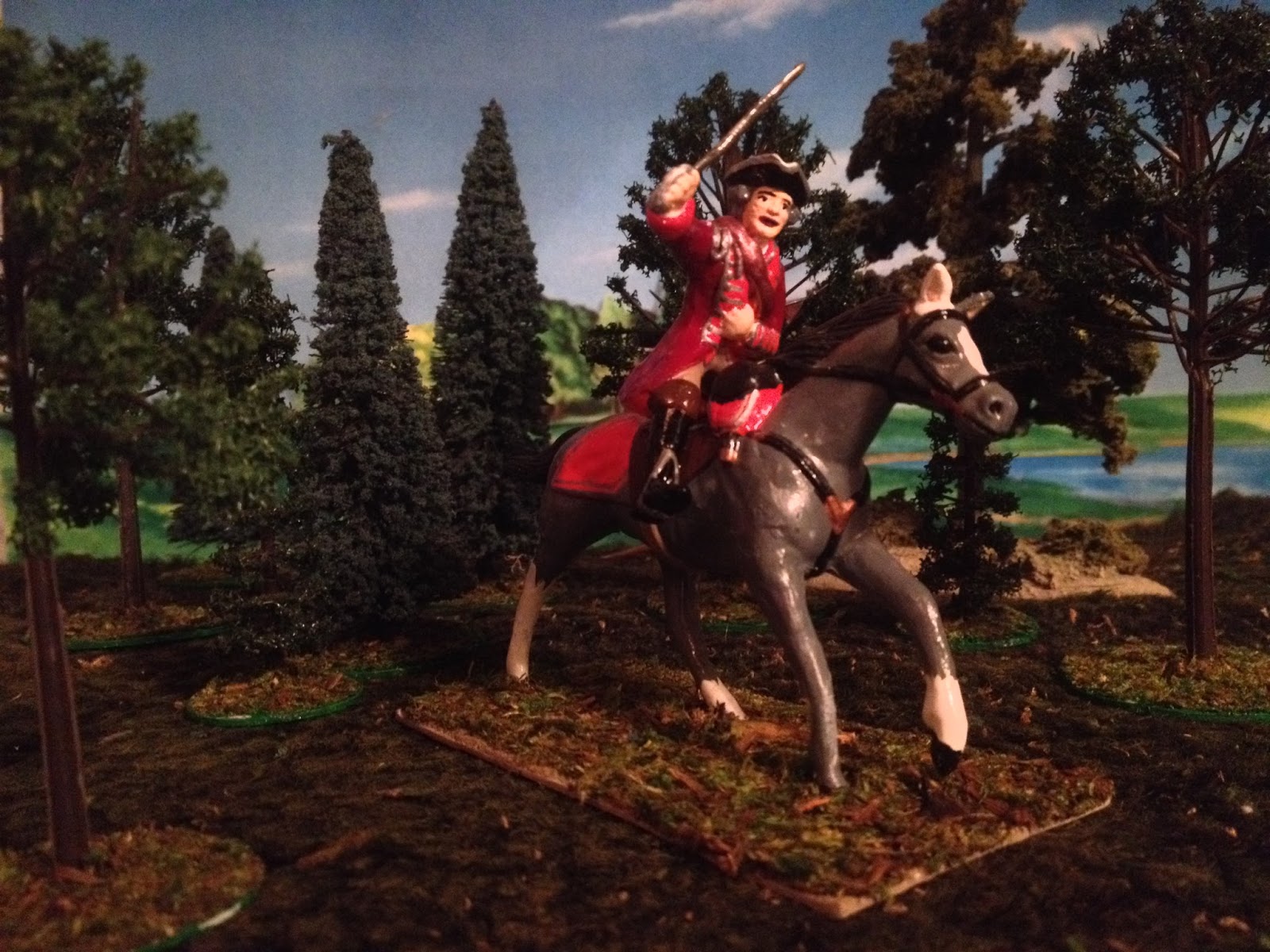
French Engineer (Reeves)


This French engineer figure was a Christmas present.  He was manufactured and painted by Reeves International, likely some time in the 1980s.  Because a little of the paint on his hand and map had begun to flake off, I repainted those sections.  I also repainted his face to blend with the rest of my collection, and repainted the flaky gold trim on his hat.


French engineers were elite specialists who were excellent at building and capturing fortifications.  Don Troiani's book Soldiers of The American Revolution states that "Although it was Washington who decided to abandon plans against New York and seize the initiative against Cornwallis it was Rochambeau and his skilled specialist troops--especially the engineers and artillery (experienced as they were in conducting large siege operations--that ultimately led to a victorious outcome." (pg. 177)

With a French specialist now serving alongside the American forces, the question arises...where is the rest of the French army?


Friday, January 5, 2018

2017 Recap part 2--Tarleton's British Legion

(to see the previous installment of 2017 figures, visit https://redcoatsandruffles.blogspot.com/2017/12/2017-recap-part-1-french-indian-war.html)


The unit that I made the most progress on during 2017 was Banastre Tarleton's British Legion.  Four riders and their horses were begun and finished in the year.


Charge!


Many American militiamen experienced this scene as Tarleton's hard-riding cavalry slammed into their lines.


Stay tuned for the next showcase of 2017 figures!

Friday, December 15, 2017

2017 Recap part 1--French & Indian War

During this year of 2017, two new figures joined my painted French & Indian War collection.
The first figure is a mounted figure of Lieutenant-Colonel George Monro of the 35th Regiment.

A side view of Lieutenant-Colonel Monro.


The next figure fought against Colonel Monro and his British regulars.  He is a French militiaman standing firing wearing summer dress.

The new militiaman joins his comrade who was finished last year (see https://redcoatsandruffles.blogspot.com/2017/01/painted-figures-of-2016.html)

Stay tuned for the next showcase of 2017 figures!

Monday, October 23, 2017

Militiaman Loading


This militiaman was closely copied from a figure in one of Don Troiani's paintings. The picture on the right shows the original painting and my miniature recreation.


This figure was heavily converted from the original figure from Accurate. Originally, the militiaman was waving his hat. After painting one of these figures, I used the other one to make the loading militiaman. The hat was cut from the hand and the arm was bent into position using heat. Due to failed attempts to bend the hand into a fist, I needed to sculpt a new hand onto him. The ramrod was created from a straight pin. The photo below shows a comparison of the original figure and my conversion.


And this is the finished result!  He makes an excellent addition to my American citizen soldiers.

Sunday, August 6, 2017

Tarleton's Cavalry

The British Legion is one unit of the American Revolution which has attained lasting fame...or infamy, depending on one's perspective.  Commanded through its American campaigns by Banastre Tarleton, the Legion was known as an effective and sometimes ruthless fighting force.  Whether fighting in the North (for example, at Poundridge NY) or the South (Camden SC), the Legion was generally the victors.  They refused to charge during the Battle of Cowpens, but they later fought desperately at Guilford Court House and executed a lighting raid against Thomas Jefferson, missing him by minutes.


Figures are Chinese copies of Italeri; heads by All the King's Men.  Heavy conversion was required on the riders and some on the horses.  Painted with Testors paints.

Thursday, June 29, 2017

Ambush!


It was just an ordinary patrol.  Five British infantrymen moving through the countryside as part of a foraging expedition.  But it quickly went awry.  Musket fire erupts through the forest as local militia seize this opportunity to harass King George's redcoats.


The soldiers of the 80th Regiment withdraws to a nearby hill and does their best to hold the militia at bay.  As they continue, the militia begins to encircle them.


It is clear to the corporal that they cannot hold out much longer against the numerically superior militia.  His only hope is that the other units in the foraging party will hear the musketry and come to his assistance.


To be continued...

Friday, June 16, 2017

Continental Artillery

Open fire!
At the beginning of the American Revolution, the Americans lacked several important components for a modern, 18th Century army.  Among these was a professional artillery corps.  By 1781, the Continental Corps of Artillery had been created and uniformed in blue coats faced with red.  Sergeants wore yellow lace on the coat, and all ranks wore yellow trim on their tricorn hats.


The crew prepare to load the gun
The Continental Corps of Artillery participated in many engagements. In 1781 alone (which year these figures are painted to represent), they fought in at least four battles: The artillery fought at the Battle of Cowpens, the Battle of Guilford Courthouse, the Battle of Green Spring, and the Siege of Yorktown.


A Three-Pounder "Grasshopper" Cannon


Figures by BMC, painted with Testors paints.  No conversions were done to these figures.  The artillery piece was included in a set of DGN "American Revolution" figures.  It is painted to represent a versatile 3-pounder "Grasshopper" cannon.  Cannons were measured by the weight of the ball they threw; so a three-pounder cannon would fire a three-pound cannonball.