Showing posts with label American Revolution. Show all posts

Monday, November 18, 2019

Skirmish at Turnbull's Farm

From Lieutenant Francis Monypenny, 2nd Pennsylvania Regiment
To Col. Walter Stewart, 2nd Pennsylvania Regiment

Dear Sir,

Your orders of the 3rd instant were punctually observed by Capt. Duckworth & myself.  Whilst ranging the countryside in search of the enemy's movements, we had a smart skirmish near Turnbull's Farm.

Both of Capt. Duckworth's light infantry companies, a company of militia, and the troops of our ally Louis XVI met the enemy in the clearing near Turnbull's Farm.

The enemy were one grenadier and one battalion company of the 80th Regiment, as well as the banditti of Col. Tarleton's corps.  The whole was commanded by Captain Phillips, whose daughter Sarah (as you may well remember) was arrested for her imprudently expressed opinions on our glorious Congress.  Captain Duckworth was tasked with escorting her to the court house for inquiry.

I was thankful to know that Capt. Phillips commanded the advance guard of the enemy, for a spy has indicated clear signs of disaffection within his company.  They said that their lives would not be sacrificed to find his daughter.  To regain his former popularity, he would have to take an active part in the coming fighting as a member of the advance guard, rather than remaining comfortably with the main army.

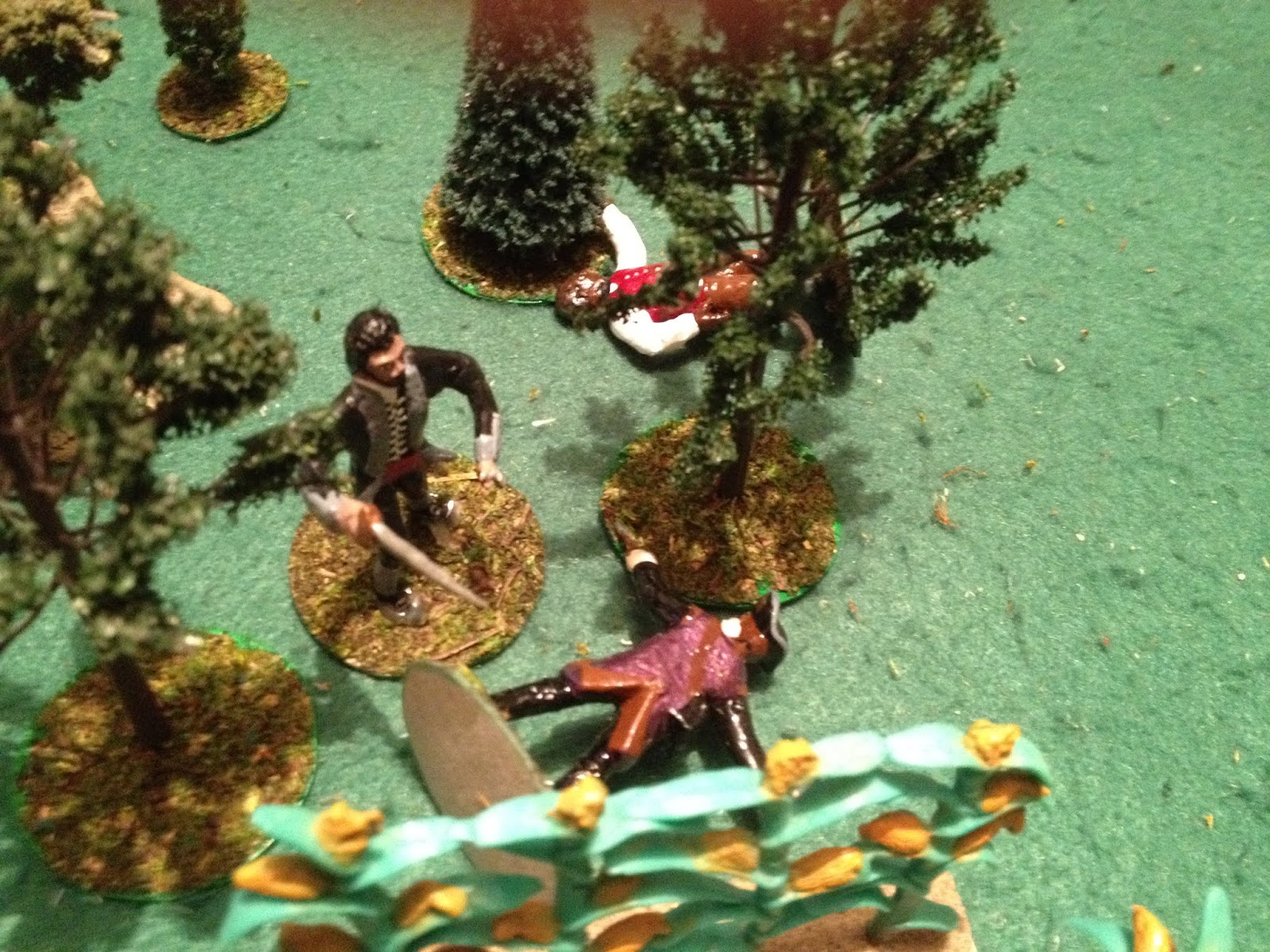
Both sides moved cautiously through the woods.  First blood went to the Gatenois Regiment, who killed one of Tarleton's troopers with a long-range volley.  The steady discipline of our French allies (as well as their superior quality powder) is something which should be introduced to more of our army.

In the confusion of our march, Sarah Phillips escaped.  However, Captain Duckworth retook her.

The battalion company of the 80th Regiment decimated the new-raised light infantry company with a volley.

As the smoke mounted, reinforcements entered the battle.  We received one company of the 2nd Pennsylvania Regiment.  On the other side, the Volunteers of Ireland entered.

Musketry near the cornfield caused no casualties, but Captain Phillips shot one light infantryman with his pistol.

The 80th fired at a unit of militia moving through the woods and caused one casualty.

The light infantry's volley hit one British grenadier.

The French Regiment Gatenois continued to hold the center of our line, causing a casualty in the Volunteers of Ireland.

A second company of the 2nd Pennsylvania appeared to reinforce the Americans, commanded by your humble servant.

Captain Duckworth ordered his light infantry to storm the fence and fight the grenadiers hand-to-hand.  How much has changed since we ran from crossing bayonets with the feared grenadiers!  But success frowned on the captain, as he lost his entire company for the loss of one grenadier.  I am assured by militia standing nearby that Captain Phillips himself killed two of our men with his sword.


The nearby militia returned fire and killed two grenadiers.

Tarleton's cavalry rashly charges the same militia...and is wiped out to a man with a well-timed and disciplined volley.  I salute the county lieutenants whose untiring efforts sent us these militia.  Their discipline was remarkable.

The light infantry on our left inflicts one casualty on the 80th Regiment.  This causes them to fall back in considerable disorder.  I move my company up and order a volley into the disorganized rabble, who rout and will take no more part in the fighting.


Our French allies of Regiment Gatenois continues their steadfast performance, causing two more casualties in the Volunteers of Ireland.  It is said that they were once the proud Regiment Auvergne, and truly they proved themselves worthy of the title.  Shaken by the flight of the 80th, the Volunteers rout as well.

Worse was to befall the British, for Captain Phillips is caught outside the cornfield by a volley from the 2nd Pennsylvania's.  He falls, likely unaware that his daughter has finally succeeded in freeing herself from captivity.

All of the American units now converge on the grenadiers defending the cornfield.  The grenadiers decide that their honor is still intact and withdraw off the field, carrying the body of their captain.

British casualties are 14 men, including Capt. Phillips; American casualties, 12.  Half of the British force did not even enter the battle.

As you requested, I remained out of the line of sight of the British force, for matters of a delicate nature precluded meeting them hand-to-hand on the field of Mars.  Some of my men believe that the enemy may have sighted me, but no one is certain.

Reports are current that Lieutenant Fenworthy, whose father is a well-known Radical in Parliament, commanded a company of the 80th Regiment which was late in arriving to the battle.  Common report says that Fenworthy has been heard to express some sympathy with our glorious cause of liberty and did not wish to kill any to further the schemes of Lord Germain and Lord North.

Requesting your orders for future dispositions of the advance guard,
I remain, Sir, your most obedient & humble servant,
Lieutenant Francis Monypenny. 2nd Pennsylvania Regt.
Sarah Phillips escaped...

Rule set: Muskets & Tomahawks.  Each side had two officers with a side plot apiece.  The side plots added a very nice touch of storyline to a skirmish game.  It is not hard to work the side plots into cohesive characterization of the officers.  Look for more adventures from them...

Captain Duckworth: Side plot: Hostage.  Failed, Sarah Phillips escaped.

Lieutenant Monypenny: Side plot: Spy.  Uncertain if succeeded, came very near the maximum spotting distance of the 80th Regiment.

Captain Phillips: Side plot: Disdained.  Succeeded, killed the equivalent of 5 enemy soldiers.

Lieutenant Fenworthy: Side plot: They were my brothers.  Succeeded, never entered the battle.

Sunday, March 10, 2019

Gaskins's Virginia Battalion (W. Britains)

This soldier loading his musket is a member of Gaskins's Virginia Continental Battalion in 1781.  Virginia's Continental troops had first served with Washington's main army in the North.  When the British began operations in the South, Virginia Continentals were sent to reinforce them.  Since Virginia remained relatively war-free, this was possible.

But everything changed when Benedict Arnold landed at the head of another expedition in late 1780-1781.  Virginia's troops were in South Carolina, and troops were badly needed to stop Arnold's destruction.  Yet more Continental (regular, as opposed to militia) troops were raised, under the command of Colonel Thomas Gaskins.

Despite being a Continental regiment, Gaskins's troops were poorly supplied.  "Virginia lost a great deal of her stockpiled supplies following the sack of Point of Fork arsenal by a Loyalist and British force on June 5, 1781.  Even prior to this, proper linen for hunting frocks was lacking, leading the state clothier to make up 'short coats' or jackets of coarse canvas with blue facings as an expedient summer uniform." [1]


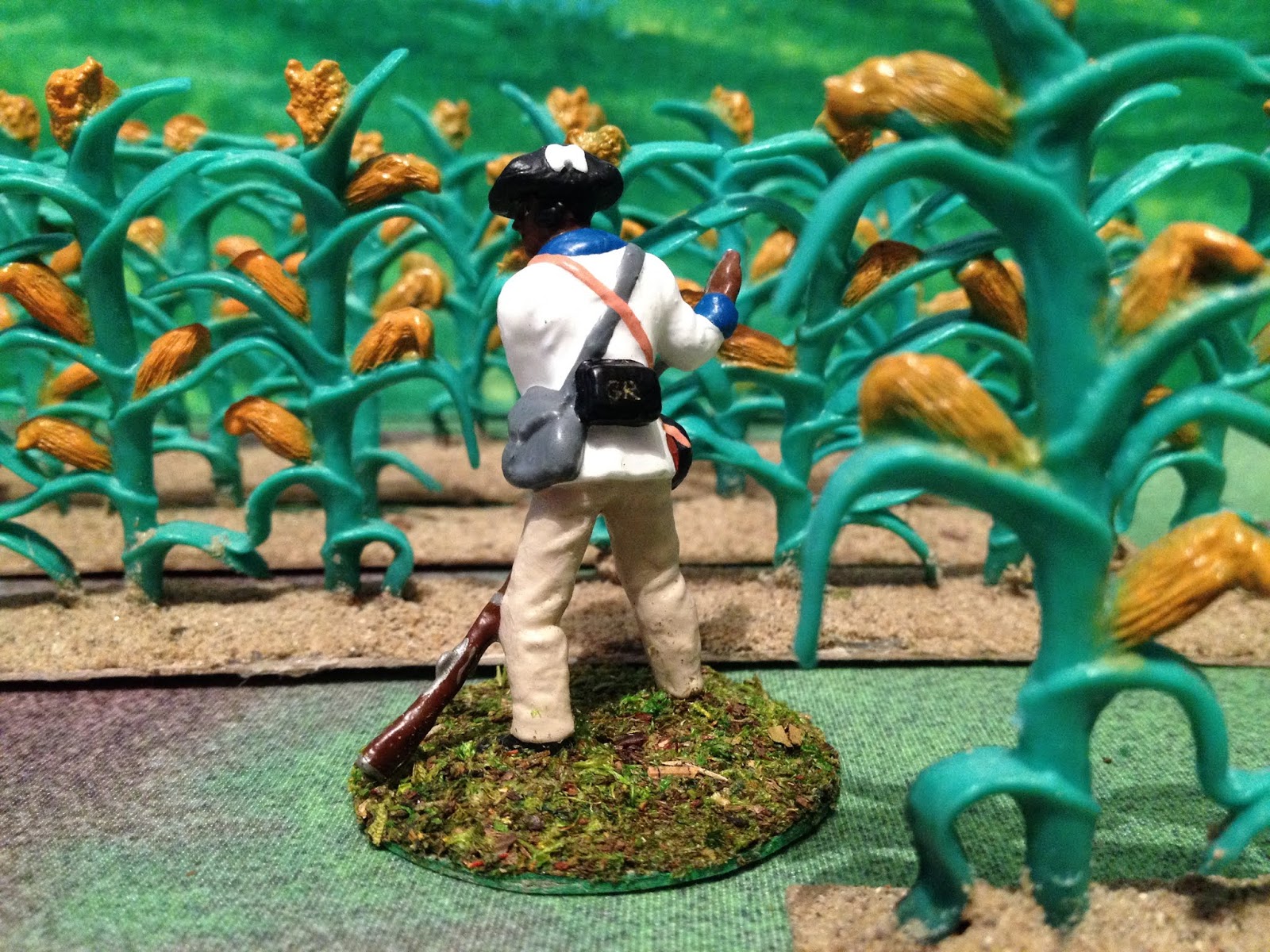
This soldier wears one of these jackets.  His haversack may be issued by the Continental Army, captured from the British, or a private purchase.  His cartridge box is a former British item, and he has not removed the "GR" marking from it. (see photo at left) 


However, this soldier proudly shows his allegiance to the ideals of the American Revolution on his canteen, where he has carved "Liberty" on its side.

The figure began as a Britains "Deetail" Civil War figure.  The kepi was removed and a roundhat with cockade sculpted in its place.  Cuffs and collar were also added, and the bayonet scabbard removed.


Figure painted with Testors and CraftSmart paints; sealed with Mod Podge.


[1] James L. Kochan.  Don Troiani's Soldiers of the American Revolution, pg. 166.

Saturday, November 10, 2018

Continental Light Infantry in Hunting Shirts

These two figures belong to the Continental Light Infantry.  They are dressed and equipped for Lafayette's Virginia campaign of 1781.  According to the records, some units wore traditional light infantry coats (that is, the coattails were cut short), while others were issued hunting shirts. [1]


The light infantry formed the backbone of Lafayette's force.  With these men, Lafayette attempted to defend Virginia against British raiders under Benedict Arnold, and later, Lord Cornwallis.

After the battle of Green Spring (July 6, 1781), Lafayette wrote in General Orders that: "The brilliant conduct of Major Galvan and the continental detachment under his command, entitle them to applause." [2]  These men were true veterans of the Continental Army.


References
[1] John U. Rees.  "Their presence here...has saved this state": Continental Provisional Battalions with Lafayette.  Pg. 33.  Available at http://revwar75.com/library/rees/pdfs/light.pdf

[2] Marquis de Lafayette.  Lafayette in the Age of the American Revolution volume IV, pg. 240.

Tuesday, October 9, 2018

Beyond the Mask Skirmish Game Part II

After stealing important documents from Will Reynolds (see http://redcoatsandruffles.blogspot.com/2018/09/beyond-mask-skirmish-game.html), Joshua Brand made his way to EIC headquarters to deliver the documents to his boss Charles Kemp.

Fearing that the other EIC operatives would double-cross him, Brand determined to exit the board with the documents himself (this was his victory condition).  The EIC had to take the documents from Mr. Brand to prevent any possibility of blackmail.  And unknown to both parties, Will Reynolds had survived his thrashing and was eager to recover these documents as well.  The first group to take the documents off the board would fulfil their victory conditions and win.  An unusual three-way fight was on!


The ruleset was (again) Eureka Miniatures' "And One for All"--but with a twist.  The three units were activated by drawing cards, adding an element of unpredictability.

Mr. Brand started in the forest, Will Reynolds sheltered in a cornfield, and the EIC marched down the road.

The game began with a run of EIC cards, allowing them to block the crossroads.  Mr. Brand crossed the road to the forest in the foreground of the picture, while Will made his way through the cornfield.

First contact was made by the EIC, who patrolled aggressively.  Their swordsman caught Mr. Brand in the forest and forced him into a duel.  Both sides cut and thrust at each other.  Mr. Brand retreated, only to run into Will Reynolds, who had exited the cornfield.  After a duel between the two, the EIC moved in to finish the job.  Mr. Brand was down. 

Their operative searched him for documents.  No luck (he muffed his roll; any number but a 1!).  Will searched and still could not find them.  The next turn saw the EIC locate the documents and begin to escape.

Recklessly, Will charged at the EIC soldier.  He hoped that he was weakened by his combats (as he was).  But it was not nearly enough.  The EIC prevailed against their other opponent without too much trouble.

Now that the EIC had recovered their documents, they marched triumphantly back to their boss to announce that they had successfully completed their mission.


Or had they?


(My notes: Despite the somewhat one-sided nature of the report, the game was actually fairly close.  The game could have gone any way, though Mr. Brand would have had an uphill battle.  Will was crippled by 1. his inability to find the documents and 2. his decision to charge the EIC soldier.  It was a worthwhile gamble, but did not pay off.)

Friday, September 7, 2018

Militiaman Priming

This militiaman is a conversion from Accurate's "Militia priming" figure.  The original figure had a very distinctive face with beard and balding head.  I substituted a different head from All The King's Men, and turned it so that he was looking down his gun's barrel, rather than at his priming horn.  The result is a dynamic figure (at least in my opinion!) who is keeping his eye firmly on his enemy while he is loading.  With opponents like Tarleton's Legion, this is a good idea!

Figure by Accurate; head by All the King's Men; painted with Testors paints.

Saturday, May 12, 2018

"Liberty's Kids" Character James Hiller (Marx)


This figure is based on one of the main characters from the television show Liberty's Kids.  James Hiller is an orphan who works as a reporter for Benjamin Franklin's newspaper.  He and his two comrades (one of which has been painted already; see https://redcoatsandruffles.blogspot.com/2018/01/sarah-phillips.html) view the great events of the American Revolution, from the Boston Tea Party to the signing of the United States Constitution.  Mysteriously, the characters never seem to get any older...


The original figure was a recast Marx "Johnny Tremaine."  The original head was swapped for the head from a Marx recast "Rab Silsbee."  After this rather drastic change, the character's pigtail was sculpted, a quill pen was sculpted in his right hand.  His left hand had been removed for another conversion(see https://redcoatsandruffles.blogspot.com/2017/02/young-philadelphia-gentleman.html), which necessitated sculpting another hand.  I chose to give this hand a piece of paper.  Now James Hiller and his companion Sarah Philips are ready to jot down all the latest news from the Revolution as it happens.

Sunday, April 15, 2018

Hessian Regiment von Bose (Classic Toy Soldiers)

The first unit of Hessians has landed on American shores!  These Hessians (soldiers from the principality of Hesse-Kassell) are from the Regiment von Bose. 


Hessian Regiment von Bose finds itself
fighting in wooded terrain
This Hessian regiment was sent to the southern colonies and formed a part of Lord Cornwallis' field army.  During the "Race to the Dan", Von Bose participated in the brutal slogging through North and South Carolina in pursuit of General Greene's army.  Regiment von Bose's moment of glory came during tough fighting at the March 15, 1781 Battle of Guilford Courthouse.  Continuing their career as part of Cornwallis' army, these tough veterans participated at the Siege of Yorktown and defended Redoubt #9 against an ultimately successful French attack.


These soldiers wear their regulation uniform, complete with red pompoms on their cocked tricorne hats.  The only non-regulation piece of clothing are the drab brown gaiter-trousers, which were used extensively during the Southern campaigns.

Figures were originally Classic Toy Soldiers "Hessian Grenadiers."  After carefully modifying their long gaiters into gaiter-trousers, I removed the grenadier caps and sculpted cocked hats instead.  The pompoms were provided out of my sister's collection of small plastic beads (thanks, Amara!).  They were then painted with Testors enamel and CraftSmart acrylic paints.


For a good look at the celebrated career of this regiment, check out Kabinettskrieg's blog article "He Was a Blue and Bloody Man: The Von Bose Regiment." https://kabinettskriege.blogspot.com/2017/07/he-was-blue-and-bloody-man-von-bose.html

Saturday, March 10, 2018

Militiaman from Mollo and McGregor (Accurate)


Classic book illustration meets miniature figure.
This militiaman is based on a plate from the classic Mollo & McGregor book Uniforms of the American Revolution.  The picture shows him just to the right of his namesake.


The original figure was an Accurate militiaman.  All Accurate figures have been a joy to paint due to their incredibly detailed sculpting.  Unlike some of my more involved and complex conversions (see https://redcoatsandruffles.blogspot.com/2017/10/militiaman-loading.html), I only made a few changes to this figure.  These were shaving the engraved motto "Liberty" off his cap, leaving it plain, and removing the tops of his gaiters to paint them as striped stockings.

Is he guarding a notorious Loyalist, or a cache of supplies?


This figure gives me a wonderfully versatile militiaman who looks equally at home in the North and South, who looks well-dressed, who can easily be plugged into an urban setting, and who is professional enough to be trusted with guard duty.


Figure by Accurate; painted with Testors and Michael's "Craft Smart" paints.


Friday, March 2, 2018

Allies Arrive

This blog has mostly featured British and Loyalist troops opposed by American revolutionaries.  Now this trend is changing.  A treaty of alliance has been signed and His Majesty Louis XVI has sent soldiers to aid the Americans in their struggle against Britain.


More French infantrymen will be arriving in the forthcoming months.  To read more about the engineer and the role of the French Royal Engineer Corps in the American Revolution, visit https://redcoatsandruffles.blogspot.com/2018/01/french-engineer.html

Wednesday, January 24, 2018

"Liberty's Kids" Character Sarah Phillips (Marx)


Miss Sarah Phillips scouts for news in a colonial town.
(click picture to enlarge)
This figure is based on one of the main characters from the television show Liberty's Kids.  In the show, three youngsters serve as journalists for Benjamin Franklin and report on the major--and sometimes minor--events of the American Revolution.  This figure, Miss Sarah Phillips, is the daughter of a British Army officer serving in America.  In the first episode, Sarah comes to America to find him.  During the ongoing show, she provides a British/Loyalist perspective to much of the reporting done.

The figure herself began as a recast Marx "Cilia" figure.  Much change was required to transform her into Sarah Phillips.  From top to bottom: the cap was removed and hair sculpted, golden locket added, neckline squared off, shawl removed, quill pen sculpted, flair and length added to sleeves, pointed bodice, piping down front of dress, and paper to record news.  Whew!  This is some of the most work I have ever done to convert a figure.  However, I believe that the final product was well worth the effort.


Original figure on left; Sarah Phillips on right.
(click picture to enlarge)

Saturday, January 13, 2018

French Engineer (Reeves)


This French engineer figure was a Christmas present.  He was manufactured and painted by Reeves International, likely some time in the 1980s.  Because a little of the paint on his hand and map had begun to flake off, I repainted those sections.  I also repainted his face to blend with the rest of my collection, and repainted the flaky gold trim on his hat.


French engineers were elite specialists who were excellent at building and capturing fortifications.  Don Troiani's book Soldiers of The American Revolution states that "Although it was Washington who decided to abandon plans against New York and seize the initiative against Cornwallis it was Rochambeau and his skilled specialist troops--especially the engineers and artillery (experienced as they were in conducting large siege operations--that ultimately led to a victorious outcome." (pg. 177)

With a French specialist now serving alongside the American forces, the question arises...where is the rest of the French army?


Friday, January 5, 2018

2017 Recap part 2--Tarleton's British Legion

(to see the previous installment of 2017 figures, visit https://redcoatsandruffles.blogspot.com/2017/12/2017-recap-part-1-french-indian-war.html)


The unit that I made the most progress on during 2017 was Banastre Tarleton's British Legion.  Four riders and their horses were begun and finished in the year.


Charge!


Many American militiamen experienced this scene as Tarleton's hard-riding cavalry slammed into their lines.


Stay tuned for the next showcase of 2017 figures!

Monday, October 23, 2017

Militiaman Loading


This militiaman was closely copied from a figure in one of Don Troiani's paintings. The picture on the right shows the original painting and my miniature recreation.


This figure was heavily converted from the original figure from Accurate. Originally, the militiaman was waving his hat. After painting one of these figures, I used the other one to make the loading militiaman. The hat was cut from the hand and the arm was bent into position using heat. Due to failed attempts to bend the hand into a fist, I needed to sculpt a new hand onto him. The ramrod was created from a straight pin. The photo below shows a comparison of the original figure and my conversion.


And this is the finished result!  He makes an excellent addition to my American citizen soldiers.

Sunday, August 6, 2017

Tarleton's Cavalry

The British Legion is one unit of the American Revolution which has attained lasting fame...or infamy, depending on one's perspective.  Commanded through its American campaigns by Banastre Tarleton, the Legion was known as an effective and sometimes ruthless fighting force.  Whether fighting in the North (for example, at Poundridge NY) or the South (Camden SC), the Legion was generally the victors.  They refused to charge during the Battle of Cowpens, but they later fought desperately at Guilford Court House and executed a lighting raid against Thomas Jefferson, missing him by minutes.


Figures are Chinese copies of Italeri; heads by All the King's Men.  Heavy conversion was required on the riders and some on the horses.  Painted with Testors paints.

Thursday, June 29, 2017

Ambush!


It was just an ordinary patrol.  Five British infantrymen moving through the countryside as part of a foraging expedition.  But it quickly went awry.  Musket fire erupts through the forest as local militia seize this opportunity to harass King George's redcoats.


The soldiers of the 80th Regiment withdraws to a nearby hill and does their best to hold the militia at bay.  As they continue, the militia begins to encircle them.


It is clear to the corporal that they cannot hold out much longer against the numerically superior militia.  His only hope is that the other units in the foraging party will hear the musketry and come to his assistance.


To be continued...

Friday, June 16, 2017

Continental Artillery

Open fire!
At the beginning of the American Revolution, the Americans lacked several important components for a modern, 18th Century army.  Among these was a professional artillery corps.  By 1781, the Continental Corps of Artillery had been created and uniformed in blue coats faced with red.  Sergeants wore yellow lace on the coat, and all ranks wore yellow trim on their tricorn hats.


The crew prepare to load the gun
The Continental Corps of Artillery participated in many engagements. In 1781 alone (which year these figures are painted to represent), they fought in at least four battles: The artillery fought at the Battle of Cowpens, the Battle of Guilford Courthouse, the Battle of Green Spring, and the Siege of Yorktown.


A Three-Pounder "Grasshopper" Cannon


Figures by BMC, painted with Testors paints.  No conversions were done to these figures.  The artillery piece was included in a set of DGN "American Revolution" figures.  It is painted to represent a versatile 3-pounder "Grasshopper" cannon.  Cannons were measured by the weight of the ball they threw; so a three-pounder cannon would fire a three-pound cannonball.


Friday, February 3, 2017

Young Philadelphia Gentleman


This figure represents a young gentleman in the 18th century meaning of the term.  A gentleman was a man who owned property and was financially well-off.  This young gentleman certainly fits that description.  Wearing a silver-laced hat, a ruffled cravat, and large silver buckles on his shoes, he shows that he is well-to-do.  While his coat, waistcoat, and breeches may look like they are all the same color, the coat is actually slightly lighter than the breeches and waistcoat.


The figure is converted from two Marx recast colonial "Johnny Tremaine" characters.  "Sam Adams" provided the entire body, while "Johnny Tremaine" provided the head and cupped left hand (the figure's left is on the viewer's right).  The head was sculpted to look like a younger person, and the hand was changed because the original figure carried a tricorne hat in his left hand. 

Just like in a previous post, in which I copied a costume my sister wore, he wears a costume which my brother wore during the filming of Beyond the Mask, a Christian movie set in the American Revolution.  The last picture shows both of them walking near a colonial house.  But there are still more family members to be created...
 

Wednesday, January 11, 2017

First Figure of 2017!


This Ideal militiaman is the first figure which I finished in 2017!  He is not an original Ideal figure, but is recast.  Since he wore a bicorne hat, I cut it down and sculpted a roundhat turned up on one side instead.  In addition, I lengthened his waistcoat, making him look more like a militiaman of 1776 than 1812.  His socks are medium blue with light blue stripes, an interesting combination which I like.  Click on the pictures to expand them.  Figure by Ideal (recast), painted with Testors Paints.