Showing posts with label AWI British. Show all posts

Friday, July 7, 2023

Lieutenant Gillette (Hawthorne Village)


Introducing Lieutenant Gillette of the Royal Navy!  A dedicated pirate hunter, he is not above acknowledging a worthy opponent.  He is a conversion of Hawthorne Village's Commodore James Norrington figure.  Gillette's arm is bent down near his waist and he is armed with a drawn sword (the blade is made with a pin).


The figure's uniform is closely copied from his appearance as Norrington's lieutenant in Pirates of the Caribbean.  Gillette's elegant blue and white uniform outshone Norrington's, so a purchase of more gold lace was in order for the proud Commodore.  Now he feels that he has a sufficient amount of gold lace to make his rank easily apparent.


Four inhabitants of Port Royal.  Are more coming soon?


Not every member of the Royal Navy is always chasing pirates on the high seas.  Pirates have to sell their plundered goods somehow and smugglers fill that niche--for a price.  Here Lieutenant Gillette inspects a load of merchandise being transported by a woman strongly suspected of piracy and smuggling...

Wednesday, November 3, 2021

Sailor with Cutlass (Mars)


 Hoist the sails, me hearties!  Another jolly tar has joined the Royal Navy.  This figure is originally from Mars Figures (https://www.michtoy.com/item-MAF-32020-Pirates_of_the_Caribbean.html).  He wears a jacket with very short sleeves, perhaps originally designed for a smaller sailor.  He wears a cap and neckcloth like many other sailor figures.  The most unusual feature of his clothing is the pair of petticoat trousers that he is wearing.  It is most gratifying to see a figure wearing these, as they were a common item of clothing for sailors (for illustrations of petticoat trousers, see https://www.britishtars.com/search/label/petticoat%20trousers).  Most other sailors in this scale make do with breeches or long trousers, which were also common.

The only conversion work that was done on him was to remove his waist sash, which was an uncommon piece of equipment for a British sailor, and replace it with a generic leather belt.

The Royal Navy is recruiting to chastise His Majesty’s rebellious subjects!

Wednesday, March 24, 2021

Queen's Ranger Charging Bayonet (BMC)


This Queen's Ranger was the first completed figure of 2021.  With the gleaming bayonet that tips his Brown Bess musket (by Helmet Soldiers), he will strike terror into the hearts of the rebels!


He is originally a BMC figure (left) who was stabbing upward (at a horseman?).  Removing his arms and swapping them with a BMC grenadier (right) gave him the ideal waist-high position for charging the bayonet.


The musket is a Brown Bess by Helmet Soldiers (available at http://www.helmetsoldiers.co.uk/weapons2.html, reviewed at https://redcoatsandruffles.blogspot.com/2020/06/helmet-soldiers-muskets-and-pistols.html).

When taking these photographs, I realized that the crescent on the Ranger's helmet was accidentally washed away by the varnish and not repainted.  Soon that will be remedied and he can proudly take his place alongside the rest of the Queen's Rangers.


Figure by BMC, musket by Helmet Soldiers.  Painted with acrylic and enamel paints, sealed with Hobby Lobby brand matte varnish.

Wednesday, February 17, 2021

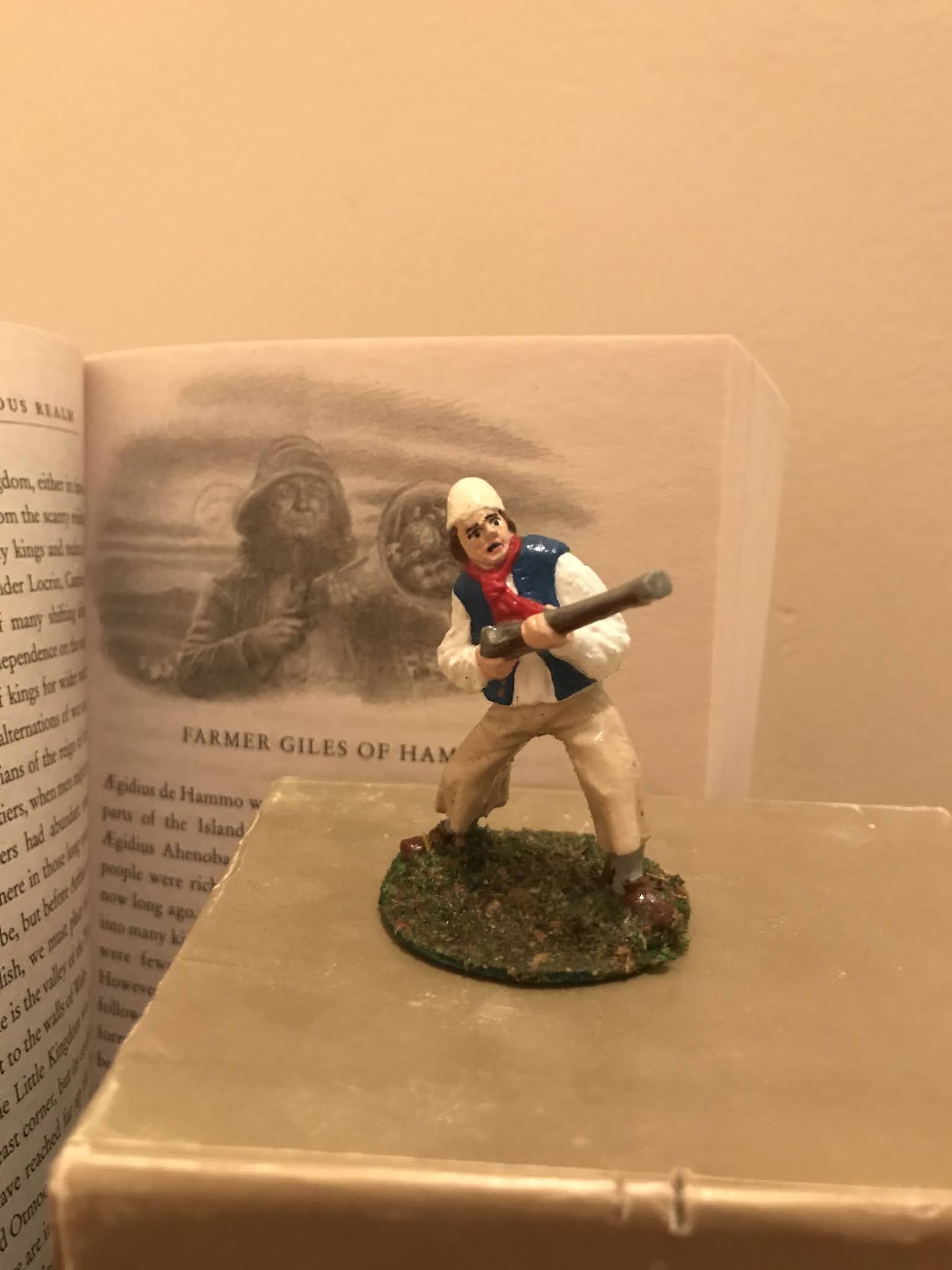
Sailor with Blunderbuss (Mars)


This jolly tar is one of eight figures released by Mars as part of their recent "Pirates of the Caribbean" set (mine was from https://www.michtoy.com/item-MAF-32020-Pirates_of_the_Caribbean.html)  Soon I will review the set all together, but I wanted to focus on this particular figure for now.

He wears long trousers typical of seamen from c. 1750 on.  His short unbuttoned waistcoat allows his shirt to be seen tucked into his trousers.  He wears a nondescript knit cap and a useful neck cloth.  Armed with a blunderbuss, he is ready to repel boarders.

Since he is a generic 18th Century sailor, he would be equally at home in King George's or King Louis' navy, as a pirate or a minuteman.  His versatility is his strongest selling feature.  In fact, you might consider purchasing Mars' Pirates of the Caribbean just to add this figure to your navies or militia.


But there is one other unusual use for him.

His pose is an excellent recreation of Alan Lee's illustration of Farmer Giles of Ham, the hero of the book of the same name by J. R. R. Tolkien.  At one point in the book, Farmer Giles picks up his blunderbuss against a trespassing giant.  Now you can recreate this scene with this figure!  I would recommend sculpting a beard, as Farmer Giles is described as wearing one.

Tuesday, November 24, 2020

Queen's Ranger (BMC)

Private Brian defends the fence

Following my review of Helmet Soldiers' muskets & pistols (at http://redcoatsandruffles.blogspot.com/2020/06/helmet-soldiers-muskets-and-pistols.html), I wanted to show off the completed Queen's Ranger who modelled the Brown Bess musket.


Meet Private Brian, named in honor of Brian Carrick (www.CollectingToySoldiers.blogspot.com) who was kind enough to admire the figure while he was still a work-in-progress.  


Private Brian is converted from a rather useless bayoneting upward BMC pose.  Instead of him bayoneting  horsemen (or flying insects), I melted his arms downward and added the Helmet Soldiers'  Brown Bess musket.  The resulting pose is typical of the 1740s drill manual "Charge Your Bayonets".  By the late 1750s, the preference was for the musket and bayonet to be waist-high.  However, I am sure that in the heat of battle, some soldiers reverted to the older style.  Even LOD Enterprises "Continental Soldiers" has a figure that is charging bayonet in the 1740s style (see photo opposite).

Figure by BMC, painted with a mix of acrylic and enamel paints.  Sealed with Hobby Lobby Matte Varnish.


Queen's Rangers defend a farmstead and fence rail as Continental troops attack.


Sunday, August 23, 2020

43rd Regiment of Foot


The 43rd Regiment had a very long service history in North America during the American Revolution.  Its light infantry company was a part of Pitcairn’s expedition against Concord in 1775 and the entire regiment participated in the battle of Bunker Hill.  In 1776, the 43rd participated in the Long Island expedition.  The regiment then spent a few years garrisoning Newport, Rhode Island, where they defended it against a joint French-American attack.

2 units of Dundas's Brigade.  1 more to go...
General Sir Henry Clinton evacuated Newport, bringing the 43rd back to New York.  They remained in garrison in New York until April 1781, when they were sent to reinforce General Cornwallis' army in Virginia.  They arrived in Virginia just in time to play a major part in the battle of Green Spring (July 6, 1781).  As a part of Colonel Dundas's brigade, they ambushed Anthony Wayne's advance and inflicted heavy casualties on his brigade of Pennsylvanians (including the 2nd Pennsylvania http://redcoatsandruffles.blogspot.com/2016/04/2nd-pennsylvania-regiment-by-armies-in.html).


Of course the 43rd followed Cornwallis to Yorktown, where they were forced to surrender on October 19, 1781.  At the end of the siege, Banastre Tarleton records 1 captain and 11 rank and file of the 43rd missing, along with 10 killed and 18 wounded. [1]
At Yorktown, the 43rd Regiment also surrendered its King's and Regimental colours to the Americans, the most senior regiment to do so.  The 17th, 23rd, and 33rd colours disappeared.  Tradition speaks of the escape of the 23rd and 33rd colours, but is silent on the 17th.


Commodore Norrington (find him at http://redcoatsandruffles.blogspot.com/2019/12/commodore-james-norrington.html) begs leave to mention that these soldiers can also be placed under his command as a unit of marines.  No pirates or rebels will be able to stand before them!  He is disappointed, however, that these brave soldiers have not been granted the coveted title of "Royal Marines".  (This will happen in 1799, Commodore Norrington, so keep your chin up!) 

What does Norrington think of campaign uniforms?
Figures by Accurate (British Infantry Set #2 ) and A Call to Arms (American Maryland Infantry https://www.michtoy.com/item-CTA-010-Maryland_Infantry.html).  Both mix very well together.  Since the figures from Accurate had a mix of legwear (high gaiters and half-gaiters) and accoutrements sculpted, I decided to represent a slightly more "campaign" unit than the 80th.  Some have their hats cocked on one side, and some wear gaiter-trousers.  Painted with a mix of enamel and acrylic paints.

Notes
[1] History of the Campaigns in the Southern Provinces.  Banastre Tarleton.  https://archive.org/details/historyofcampaig00tarl/page/n477/mode/2up

Thursday, July 30, 2020

Queen's Ranger Officer

"When did the rebels pass this way, madam?"
With the Queen's Rangers' recruiting drive kicking into high gear, they needed an officer in dapper uniform to attract likely lads...or intimidate rebel sympathizers...or charm those with valuable information.


This gentleman fills that role.  He began as one of BMC's artillery crewmen brandishing a sword while firing a pistol.

I often mention the steps involved in converting a figure, but a picture is worth a thousand words.  The original figure was cast in blue, and everything that is white on him was sculpted in Milliput.

His uniform is worth noting in some detail.  There are four known portraits illustrating Queen's Rangers officers' uniforms (Colonel Simcoe, Captain Saunders, Cornet Jarvis, and Ensign Smith) along with Cornet Jarvis's coat.  Two portraits of them (Saunders and Jarvis) show short V-shaped cuffs with herringbone lace.  Colonel Simcoe's unfortunately does not allow us to see his cuffs.  Ensign Smith's portrait shows round cuffs and buttonhole lace on the cuffs.

Captain Saunders [1] and Cornet Jarvis [2] both held commissions in the cavalry of the Queen's Rangers, while Smith held one in the infantry [3].  Their cuffs would then match standard British practice: V-shaped for cavalry and round for infantry.

It is true that Ensign Smith's portrait does not show an officer's sash, but there is one associated with Cornet Jarvis's coat.  I opted to add one to my figure.


"Open that door!"

Proudly wearing the green coat of the Queen's Rangers, this officer is ready to chastise the rebels!


Notes
This section is greatly indebted to Dr. Gregory Urwin for collecting all known portraits of the Queen's Rangers and the branch of service in which each of them held commissions.

[1] pg. 174. History of the Queen's Rangers by James Hannay, DCL. (Ottawa: Royal Society of Canada, 1909).  Online. https://archive.org/details/historyofqueensr00hannuoft/page/174/mode/2up.

[2] pg. 186, ibid. https://archive.org/details/historyofqueensr00hannuoft/page/186/mode/2up. The fact that he was commissioned a cornet also shows that he served in the cavalry.

[3] pg. 171, ibid. https://archive.org/details/historyofqueensr00hannuoft/page/171/mode/2up.

Thursday, December 19, 2019

Commodore James Norrington (Hawthorne Village)

This figure was originally named Commodore James Norrington, and I kept the name.  He is a recasting of the original, but some conversion work was done (most notably lengthening his sword from a letter opener into a blade for a true gentleman).


The sculpt was lovely and captured the personality of an aristocratic 18th Century officer perfectly.


He was painted as an officer of the British Royal Navy.  He appears happy to command a detachment of Marines, since he currently lacks a ship.


Figure cast with Amazing Casting Resin.  Painted with a mix of acrylics and enamels.

Wednesday, July 31, 2019

Queen's Ranger (BMC)

About a month ago, I had the opportunity to acquire a sizable quantity of BMC figures for a rather low price.  Some BMC figures are well-sculpted and some are not.  However, I was eager for the challenge of converting them all into formidable troops that could join the rest of my armies.

The first unit to begin recruiting was the Queen's Rangers, thanks to their easily-painted green-faced-green uniforms.  The Queen's Rangers was a Loyalist unit that became well regarded, battling Continentals and militia in the numerous skirmishes around New York City.  They were then sent to Virginia as part of Benedict Arnold's expedition to cripple that state's war effort.  The Queen's Rangers were extremely effective in Virginia, but were eventually part of the Yorktown surrender.

The original figure began looking much like the unpainted figure on the left.  Conversion began by softening the plastic in boiling water, then bending the musket arm to a more useful angle, since I was not creating the Anti-Drone Company of the Queen's Rangers.

Left figure: anti-drone work; right figure: everything else
 After that, only a few minor changes were needed.  These were:
1. Turning the legwear into gaiter trousers,
2. reshaping the cartridge box slightly
3. Adding a plume to the cap
4. Correcting the length of the musket
5. Adding a bayonet scabbard under the haversack.
6. Adding pointed cuffs to the coat (not strictly necessary, but I think it makes the figure pop)

With these changes (and of course, paint), the figure became quite useful and visually attractive.  Now for the rest of the Queen's Rangers to finish recruiting!


Rear view of the Queen's Ranger

Sunday, August 6, 2017

Tarleton's Cavalry

The British Legion is one unit of the American Revolution which has attained lasting fame...or infamy, depending on one's perspective.  Commanded through its American campaigns by Banastre Tarleton, the Legion was known as an effective and sometimes ruthless fighting force.  Whether fighting in the North (for example, at Poundridge NY) or the South (Camden SC), the Legion was generally the victors.  They refused to charge during the Battle of Cowpens, but they later fought desperately at Guilford Court House and executed a lighting raid against Thomas Jefferson, missing him by minutes.


Figures are Chinese copies of Italeri; heads by All the King's Men.  Heavy conversion was required on the riders and some on the horses.  Painted with Testors paints.

Tuesday, March 21, 2017

Volunteers of Ireland

The Volunteers of Ireland were a Loyalist unit during the American Revolution. The regiment was designed to appeal to Irishmen—particularly those from the Continental Army. The Volunteers of Ireland wore green facings, carried an Irish harp on their cap, and marched to a song called “Success to the Shamrogue.” (see https://redcoatsandruffles.blogspot.com/2016/03/happy-saint-patricks-day-from.html) The regiment, which had been given the title of the 2nd American Regiment in 1779, was shipped to South Carolina in 1780 to aid Sir Henry Clinton in his siege of Charleston.


Charleston was captured, knocking South Carolina out of the war (temporarily) and the Volunteers of Ireland remained to garrison the area. They made up part of Cornwallis’ left wing at the battle of Camden and were able to hold off the Continentals while Cornwallis’ right routed the militia. Interestingly, at Camden, it is recorded that the Continentals charged at the Volunteers of Ireland’s flag before being solidly repulsed. The Volunteers of Ireland participated in futile chases against Francis Marion, the Swamp Fox, and fought in the bitter South Carolina skirmishes. In 1781, the Volunteers fought at Hobkirk’s Hill. As a reward for their distinguished service, they were moved onto the British regimental establishment as the 105th Regiment in 1782. (1)

Their uniform is a short red coat with green brandenbourgs and a light infantry cap with an Irish harp. I love this particular combination, as it is so unusual and dashing!

Figures by BMC. The soldier loading his musket is a conversion.  They are painted with Testors paints.

Monday, November 7, 2016

Flagbearer of the 80th Regiment of Foot

This is an ensign of the 80th Regiment of Foot (Royal Edinburgh Volunteers) carrying the King's color.  British regiments of the mid-to-late 18th century carried two colors: a King's color and a regimental color.  The King's color was a Union Jack throughout, with a wreath enclosing the regimental number in the center.  The regimental color was in the unit's facing color, with a small Union Jack in the upper left corner and a wreath enclosing the regimental number in the center.


And speaking of facing colors, this man is wearing blue facings!  Why the change from a previous post when I put the Royal Edinburgh Volunteers in yellow facings?  More information will be coming in a future post...


The figure and flagpole were from All the King's Men Toy Soldiers.  Visit their website at http://www.allthekingsmentoysoldiers.com/ATKMAWI.html


The lance head on top of the flagpole was hand-sculpted by me; the gold and crimson mixed cord is made from embroidery floss.  The flag itself was borrowed from the website "British Regimental Drums and Colors" at http://www.fifedrum.org/crfd/images/D80.htm.  Do check out this website, as it is full of the ornate flags and drums carried into battle by King George's redcoated armies.

Thursday, March 17, 2016

Happy Saint Patrick's Day from the Volunteers of Ireland!

The Volunteers of Ireland wish a Great and Glorious Saint Patrick's Day and take this opportunity to share with you their War-Song, first sung in the year of our Lord 1780 by Barny Tompson, piper to the Volunteers of Ireland.


"Success to the Shamrogue"

SUCCESS to the shamrogue, and all those who wear it,
Be honour their portion wherever they go,
May riches attend them, and store of good claret,
For how to employ them sure none better know;
Every foe surveys them with terror,
But every silk petticoat wishes them nearer,
So Yankee keep off, or you’ll soon learn your error,
For Paddy shall prostrate lay ev’ry foe.

This day, (but the year I can’t rightly determine)
St. Patrick the vipers did chase from this land,
Let’s see if like him we can’t sweep off the vermin
Who dare ‘gainst the sons of the shamrogue to stand;
Hand in hand! let’s carrol this chorus,
   “As long as the blessings of Ireland hang o’er us,
   “The crest of rebellion shall tremble before us,
   “Like brothers while thus we march hand in hand!”


St. George & St. Patrick, St. Andrew, St. David,
Together may laugh at all Europe in arms,
Fair conquest her standard has o’er their heads waved
And glory has on them conferr’d all her charms!
War’s alarms! to us are a pleasure,
Since honour our danger repays in full measure,
And all those who join us shall find we have leisure,
To think of our sport ev’n in war’s alarms!


Text of this song graciously made available by the Loyalist Institute at http://royalprovincial.com/history/music/voisong.shtml


A post about the uniform and history of the Volunteers of Ireland will be forthcoming