Wednesday, October 16, 2019

2nd Pennsylvania Regiment - LOD Enterprises

Manufacturers that produce 54mm figures for the 18th Century are fairly uncommon.  Even more unusual is a new company producing this kind of figures.  When I first heard that LOD Enterprises was creating four sets of American Revolution figures, I was very interested.  Their sets have interesting poses and excellent sculpting.  Now at last I have finished painting my first figure from them.


No conversion was done except for removing the cuff buttons and painting them to match those of the 2nd Pennsylvania.


A group shot of enlisted men of the 2nd Pennsylvania from Armies in Plastic, ATS Toy Soldiers, and LOD Enterprises.

Wednesday, August 21, 2019

35th Regiment of Foot 1757-1759 (Replicants)

The 35th Regiment is perhaps best known for forming part of the ill-fated garrison of Fort William-Henry.  They defended that fort for six days against the Marquis de Montcalm and his French, Canadian, and Indian army.  After surrendering on August 9, 1757, the defeated British troops marched out of the fort the next morning, only to be attacked by Montcalm's Indian allies.  This event became known as the Fort William-Henry massacre and was immortalized in James Fenimore Cooper's novel The Last of the Mohicans (and its many movie adaptations).

The 35th then made up a part of the British expedition sent to capture the French fortress of Louisbourg in 1758.  After a siege of about a month, Louisbourg surrendered.  In 1759, the 35th attained their moment of glory (if not as much fame as the Fort William-Henry massacre) when they fought in the Battle of the Plains of Abraham.  The 35th formed the reserve on the British right flank.  The main British battle line fired a volley, then "fixed our bayonets and, under cover of the smoke, the whole line charged." [1]  Since this contemporary account was written by an officer of the 35th Regiment, it seems likely that the 35th charged alongside the main British line.

Tradition credits the 35th with breaking the French Regiment Royal-Roussillon and capturing their colors.  The regiment is also said to have adopted white plumes after picking them from French casualties.  Unfortunately, none of my research has been able to confirm these stories.  Rene Chartrand summarizes: "Regimental legend has it that the 35th captured a colour of the Royal-Roussillon Regiment and also took white plumes from its grenadiers.  This is possible but period evidence or trophies to confirm the story do not seem to have survived." [2]

In 1760, the 35th took part in the battle of Sainte-Foy, when a French army made one last attempt to recapture Quebec.  They were then a part of the climax of the French & Indian War, the surrender of the last French stronghold of Montreal.  Afterwards they served in the Caribbean.

These figures are Replicants "British at Culloden" figures.  They are well-sculpted, though prone to significant amounts of flash.

No conversion (aside from flash removal and cuff detailing) was needed on these figures.  They were sculpted with lapels buttoned over and coat skirts unhooked, as befits the squally weather of Culloden.  While summer campaigns likely would not have looked quite like that, pre-1768 British figures in 54mm are difficult to find.  Besides, coat skirts could come unhooked in the heat of battle ;). 

Some question has arisen regarding the exact shade of orange used by the 35th.  I have followed David Morier and used a vivid orange tint, rather than an orangeish-yellow.


Notes

For more info about the 35th, including its service in the French & Indian War, please visit: http://www.kronoskaf.com/syw/index.php?title=35th_Foot

[1] Anonymous.  Seven Years' War Journal of the Proceedings of the 35th Regiment.  Online.  https://archive.org/details/sevenyearswarjou00flet/page/n93, 93.  Accessed August 21, 2019.

[2] Rene Chartrand.  Quebec 1759.  (Oxford: Osprey, 1999), 54. 

Wednesday, July 31, 2019

Queen's Ranger (BMC)

About a month ago, I had the opportunity to acquire a sizable quantity of BMC figures for a rather low price.  Some BMC figures are well-sculpted and some are not.  However, I was eager for the challenge of converting them all into formidable troops that could join the rest of my armies.

The first unit to begin recruiting was the Queen's Rangers, thanks to their easily-painted green-faced-green uniforms.  The Queen's Rangers was a Loyalist unit that became well regarded, battling Continentals and militia in the numerous skirmishes around New York City.  They were then sent to Virginia as part of Benedict Arnold's expedition to cripple that state's war effort.  The Queen's Rangers were extremely effective in Virginia, but were eventually part of the Yorktown surrender.

The original figure began looking much like the unpainted figure on the left.  Conversion began by softening the plastic in boiling water, then bending the musket arm to a more useful angle, since I was not creating the Anti-Drone Company of the Queen's Rangers.

Left figure: anti-drone work; right figure: everything else
 After that, only a few minor changes were needed.  These were:
1. Turning the legwear into gaiter trousers,
2. reshaping the cartridge box slightly
3. Adding a plume to the cap
4. Correcting the length of the musket
5. Adding a bayonet scabbard under the haversack.
6. Adding pointed cuffs to the coat (not strictly necessary, but I think it makes the figure pop)

With these changes (and of course, paint), the figure became quite useful and visually attractive.  Now for the rest of the Queen's Rangers to finish recruiting!


Rear view of the Queen's Ranger

Sunday, June 30, 2019

Continental Army Brigade

These are some brigade-level shots of the Continental Army


On the left of the picture are the converged light infantry companies.  Next to them is the 2nd Pennsylvania Regiment.  Behind the light infantry (though mostly invisible) is a light artillery piece and its crew, skillfully pointed by a French engineer.


The regular Continental infantry are in similar positions as before, but now they are backed by a substantial levy of militia.


Finally a shot of the seasoned unit, the 2nd Pennsylvania.  While they were featured in Redcoats and Ruffles before (http://redcoatsandruffles.blogspot.com/2016/04/2nd-pennsylvania-regiment-by-armies-in.html), they have been reinforced by three new figures from ATS Toy Soldiers.

Thursday, June 13, 2019

Royalty

These two figures are the first glimpse of royalty here on Redcoats and Ruffles!  Meet King Roland and Queen Miranda.

Always on the lookout for more figures from the distaff side in 1/32, this figure of Queen Miranda caught my eye.  She is a perfect match for other 54mm figures.  However, the lot I purchased her with also included her consort King Roland.  After some thought, I drafted him into my collection as well. My sister helped choose which outfit he should don for his royal duties: the red coat with the light buff breeches, accented by several medals.

While his outfit looks vaguely Regency, he still belongs in the Redcoats and Ruffles world of the 1770s-1780s.  While tighter cut coats were coming into fashion in the 1780s, this one is still ahead of its time.  Likely as a monarch, King Roland was always seeking up-and-coming styles.

Figures from Disney’s “Sofia the First” collection.  They were painted with a mix of acrylic and enamel paints and sealed with Mod Podge.

Monday, May 27, 2019

Battle--Virginia, 1781

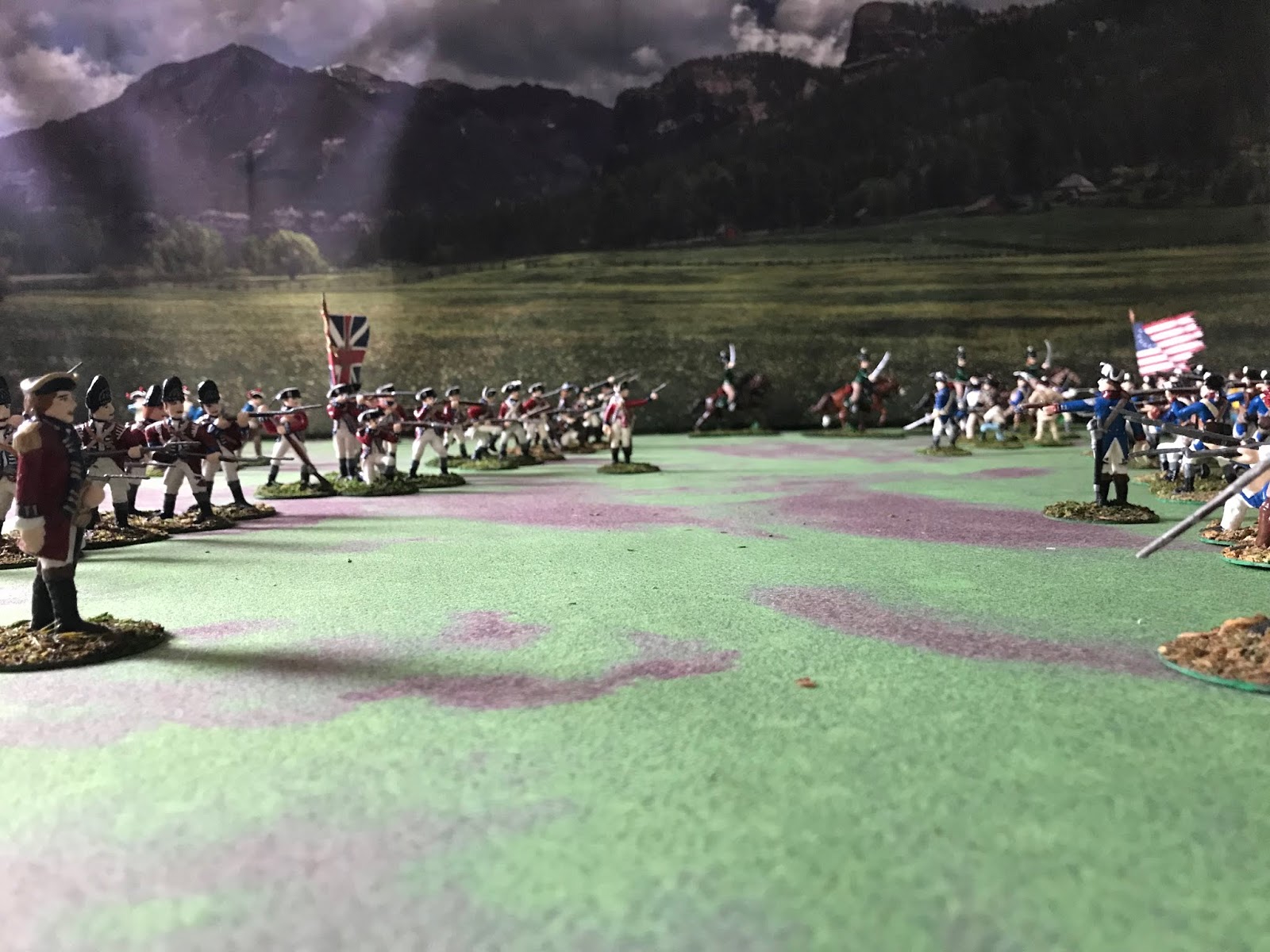
Documented in these pictures is a small encounter between the troops of His Majesty King George III and the Continental Congress, somewhere in Virginia in the hot summer of 1781.
 
The lines of regular troops march toward each other.  The 80th Regiment (Royal Edinburgh Volunteers) form the main strength of the British force.  They are opposed by the 2nd Pennsylvania, a crack Continental regiment.


Banastre Tarleton's feared British Legion sweeps down into the flank of the Virginia militia company.  Faced with yelling riders waving gleaming sabers, some of the militia break and run.  Others stay to continue their musketry duel with the Loyalist Volunteers of Ireland.

A company of Lafayette's elite light infantry moves to plug the gap left by the retreating militia.


With the militia breaking, the commanders of the Continental force see no reason to continue the fight.  They have probed the enemy's strength and will return with a full report for the Marquis de Lafayette.

Sunday, April 7, 2019

Gaston Toy Soldier (Mattel)

"No one paints up like Gaston!
Makes a swell miniature like Gaston!
No one rocks a red shirt and gloves like Gaston!" (parody of "Gaston" by Menken & Ashman)


This figure is a delightfully bizarre addition to the world of Redcoats and Ruffles.  Even though his outfit is completely unhistorical, I still enjoyed painting him and adding him to my collection.


In "Beauty and the Beast", Gaston is the villain of the piece, with an uncanny ability to quickly rally a mob.  His other abilities (including shooting and expectorating) are recounted by his lackey Lefou in a delightfully ridiculous song. (left)


In the world of Redcoats and Ruffles (following Beauty and the Beast), Gaston is enemies of both Belle and Beast.  Does that mean that he would support King George III or the Patriots?  Probably neither.  Rather than following one side, he would have no qualms switching if they failed to support him in his goal of defeating Belle and Beast.

This Gaston figure was originally released by Hasbro in 2002.  Gaston was part of a five-figure pack that included Belle and Beast in human form.  Figure painted with enamel and acrylic paints, sealed with Mod Podge.
What new adventures lie ahead?